
What Is a Guest Post in SEO? A Complete Guide
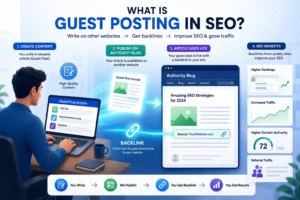
If you’ve spent any time researching link building, you’ve probably come across the term “guest post” more than once. But what is a guest post in SEO exactly, and is it still worth doing in 2026? In short, guest posting means writing and publishing an article on someone else’s website in exchange for a backlink, exposure to a new audience, or both. Done correctly, it remains one of the most reliable ways to earn relevant backlinks and grow your site’s authority. Let’s break down what it actually involves and how to do it well.
What Is a Guest Post in SEO?
A guest post is content you create specifically for another website, usually one in your industry or niche, rather than your own blog. In return for the free content, the host site typically allows you to include a link back to your website, either within the body of the article or in an author bio. From an SEO standpoint, that link is the real prize: it signals to search engines that another (ideally reputable) site finds your content worth referencing.
Guest posting in SEO isn’t just about grabbing a link, though. The best guest posts also introduce your brand to a new audience, position you as a knowledgeable voice in your field, and create a genuine relationship with the publishing site.
Types of Guest Posts in SEO
Not all guest posts serve the same purpose. Common types include:
- Link-focused guest posts: written primarily to earn a backlink to a specific page, usually a product, service, or cornerstone content page.
- Authority-building guest posts: focused less on a single link and more on positioning the writer or brand as an expert, often published on high-profile industry sites.
- Relationship-driven guest posts:written to strengthen a partnership with another brand or publisher, sometimes without a strict link requirement at all.
Knowing which type you’re aiming for helps you choose the right target sites and shape the content accordingly.
Why Guest Posting Still Matters for SEO
Backlinks and Authority
Search engines use backlinks as one of many signals to judge how trustworthy and relevant a page is. A well-placed link from a respected, topically relevant site carries far more weight than dozens of links from low-quality directories. This is one of the core off-page SEO techniques that experienced teams build into a long-term strategy, and it’s why guest posting continues to show up in most credible link-building playbooks.
Referral Traffic and Visibility
A guest post on a site with an engaged readership can send real visitors to your website, not just search engine crawlers. Even if a reader doesn’t click through immediately, repeated exposure to your name and brand across relevant publications builds familiarity and trust over time.
Relationship Building
Guest posting often opens the door to ongoing relationships with editors, bloggers, and other site owners in your space. Those relationships can lead to future collaborations, more guest opportunities, or even mentions you didn’t have to pitch for.
How Guest Posting Fits Into a Broader SEO Strategy
Guest posting shouldn’t be treated as a one-off tactic. It works best as part of a wider off-page SEO strategy that also includes things like local citations, social signals, and influencer outreach. Pairing guest posts with a solid content marketing strategy ensures the topics you write about for other sites actually align with the keywords and pages you’re trying to rank on your own site.
How to Find the Right Guest Posting Opportunities
Not every website is worth pitching. Before reaching out, check that a prospective site is:
- Topically relevant to your niche or industry
- Reasonably active, with recent posts and engagement
- Free of obvious spam, excessive ads, or low-quality outbound links
- Open to contributions, ideally with published guest post guidelines
A quick way to vet sites is to look at their existing content quality and see whether they already link out to credible sources. If their own site reads like thin, low-effort content, a link from them likely won’t help much anyway.
Best Practices for Writing an Effective Guest Post
Once you’ve secured a placement, the way you write the post matters just as much as where it’s published. A few fundamentals:
- Write content that delivers real value to the host site’s audience, not just a vehicle for your link.
- Follow the host site’s editorial and formatting guidelines closely.
- Use natural, descriptive anchor text rather than generic phrases like “click here.”
- Back up claims with credible data; Google’s own spam policies make clear that manipulative or low-value link schemes can actively hurt rankings.
- Apply the same content optimization principles you’d use on your own blog, including clear structure, headings, and a logical flow.
Common Guest Posting Mistakes to Avoid
Guest posting can backfire when it’s done carelessly. Watch out for:
- Publishing on irrelevant or low-authority sites just to get a quick link
- Over-optimizing anchor text with the exact same keyword every time
- Submitting duplicate or recycled content across multiple sites
- Treating it purely as a link play instead of genuinely useful content
- Ignoring the host site’s audience and writing only for search engines
Final Thoughts
Guest posting remains one of the more dependable ways to build backlinks, reach new audiences, and establish credibility in your industry, but only when it’s approached with quality and relevance in mind. Focus on the right sites, write genuinely useful content, and treat each guest post as a long-term relationship rather than a quick SEO trick. If you’d like help identifying guest posting opportunities and building a backlink strategy that actually moves the needle, our SEO team can help you put a plan together.
Table of Contents
Need SEO That Works?
Share This Artical:

Mazher Noor Muhammad
Generated over $100K+ Revenue & 5.7K+ Leads a month for my clients through SEO | Help Startups || Brands || Enterprise Companies to get rank on Google Search Engine | CEO & Founder of Digiown Agency