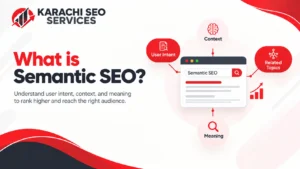
Semantic SEO is the practice of optimizing Search Engine Optimization (SEO) content around meaning, topics, entities, relationships, and search intent instead of relying on repeated exact-match keywords. The goal is to make your content clear to both users and search engines so a page can satisfy the main query and relevant related searches.
Search engines no longer depend on simple word matching. Google uses natural language processing (NLP), machine learning, artificial intelligence (AI), and entity relationships to interpret queries and content. Semantic SEO responds to this change by building comprehensive pages that explain a subject accurately, connect related concepts, and address the reason behind a search.
For a business website, semantic SEO can strengthen topical relevance, support organic visibility, improve user experience, and help individual pages rank for a wider set of related queries. Understanding how SEO supports business growth can also help businesses connect their search strategy with broader marketing objectives.
How Does Semantic SEO Work?
Semantic SEO works by connecting the meaning of a search query with the meaning and context of a webpage. Search engines analyze words, entities, relationships, page structure, links, and content context to determine whether a page provides a relevant answer.
For example, a page about “digital marketing” can naturally discuss search engine optimization, content marketing, paid advertising, analytics, conversion tracking, and audience intent. Those concepts help define the subject because each concept has a meaningful relationship with digital marketing.
Search intent remains central to this process. A user searching “semantic SEO definition” wants an explanation, while a user searching “semantic SEO services” may want professional help. Your content structure should reflect the purpose behind each query rather than treating every query as the same keyword.

Why Is Semantic SEO Important?
Semantic SEO is important because search engines evaluate context and relevance beyond exact keyword matching. Comprehensive topical coverage helps your pages address related questions, establish clear subject relevance, and compete for a broader range of search queries.
Five practical benefits make semantic optimization valuable:
- Broader query coverage: One well-structured page can satisfy several closely related searches without creating separate pages for every keyword variation.
- Stronger topical relevance: Related concepts demonstrate that your page genuinely addresses the subject rather than mentioning a keyword repeatedly.
- Better user experience: Clear answers, useful headings, and logical supporting information help visitors find what they need.
- Stronger internal architecture: Topic clusters and contextual internal links show relationships between related pages.
- Better search visibility: Relevant long-tail queries can generate additional impressions and qualified organic traffic.
What Are Entities in Semantic SEO?
Entities are identifiable people, places, organizations, products, concepts, or other distinct subjects that search engines can recognize and relate to other entities. Entity optimization helps search engines determine what a page is actually about.
For example, a page about Google Search can naturally reference Google, search rankings, Search Console, algorithms, crawling, indexing, and search intent. These entities provide contextual signals because each subject has a recognized relationship with search.
Entity coverage must remain meaningful. Adding a list of related names or terms without explaining their relationship does not create topical authority. Your content should use entities where those entities contribute information, definitions, evidence, examples, or context.
How Does Search Intent Fit Into Semantic SEO?
Search intent is the underlying goal behind a user\’s query, and semantic SEO uses that goal to determine what information a page should provide. Four common intent categories are informational, navigational, commercial investigation, and transactional.
An informational query such as “what is semantic SEO” requires a clear explanation. A commercial query such as “best semantic SEO agency” requires comparisons, service details, credibility signals, and decision-making information. A transactional query such as “hire semantic SEO services” requires a clear service proposition and conversion path.
Your page should match the dominant intent instead of forcing a sales message into an informational search. Karachi SEO Services can apply the same principle when creating service pages, guides, location pages, and supporting articles for businesses targeting Pakistan or international markets, including businesses that need a broader national SEO approach.
How Do You Find Semantic Keywords?
To find semantic keywords, start with the primary topic and identify related concepts, questions, entities, modifiers, and subtopics that help a searcher understand the subject completely.
A practical keyword research process includes:
- Analyze the primary query: Determine the topic, audience, intent, and expected answer.
- Review search results: Study headings, People also ask questions, related searches, snippets, and recurring concepts.
- Use Google Trends: Compare related topics and identify search interest patterns relevant to your market.
- Expand query variations: Find synonyms, long-tail keywords, question phrases, and service-specific modifiers.
- For location-based businesses, this process can also include keyword research to identify queries that combine services with specific cities, areas, or local intent.
- Map concepts to pages: Decide which terms belong on one page and which require separate supporting pages.
- Check competitors: Identify important subtopics that competing high-quality pages cover and determine where your content can provide stronger information.
Semantic keywords are not simply synonyms. A semantic keyword can be a related concept, entity, attribute, question, process, or term that clarifies the main topic.
How Do Topic Clusters Support Semantic SEO?
Topic clusters support semantic SEO by organizing related pages around a central subject. A well-planned SEO content strategy can help determine which topics deserve pillar pages and which should be developed as supporting content.
Suppose a website targets technical SEO. A central technical SEO guide could connect to separate pages about crawling, indexing, XML sitemaps, canonical tags, robots.txt, Core Web Vitals, structured data, and JavaScript SEO. Each supporting page adds depth without forcing every detail onto one URL.
Internal links should use descriptive, natural anchor text. Links should help users discover relevant information and help search engines understand how pages relate. Avoid creating dozens of pages only because a keyword tool shows minor variations. Separate pages need distinct search intent or meaningful informational value.
How Does Structured Data Help Semantic SEO?
Structured data helps search engines interpret specific information on a page by providing machine-readable descriptions of entities and page properties. Schema markup can identify organizations, products, articles, services, events, reviews, and other supported content types.
Structured data does not replace strong content, and valid schema does not guarantee rich results. The visible page still needs accurate, useful information that matches the structured data.
Semantic HTML supports the same principle at the page-structure level. Clear headings, lists, tables, navigation elements, and appropriate HTML elements help communicate document structure to users and automated systems.
How Do You Build a Semantic SEO Strategy?
To build a semantic SEO strategy, create a topic map before producing or rewriting content. Start with the core business topic, then define its related entities, search intents, questions, subtopics, services, and supporting concepts.
A practical workflow has seven steps:
- Define the primary topic and business objective.
- Identify the dominant search intent.
- Build a semantic keyword and entity list.
- Group related queries by intent and topical relationship.
- Create or refine pillars and supporting pages.
- Connect relevant pages with contextual internal links.
- Add appropriate structured data and measure performance.
What Are Common Semantic SEO Mistakes?
The most common semantic SEO mistakes involve adding related terms without meaning, creating thin topic clusters, confusing synonyms with entities, and producing long content that does not satisfy search intent.
Keyword stuffing remains a poor strategy. Repeating semantic keywords can make content harder to read and can weaken topical clarity. Search engines can understand natural variations without requiring repetitive wording.
Ignoring internal links also limits semantic understanding across a website. Strong pages should connect to closely related resources where those resources genuinely help the reader.
Does Semantic SEO Improve Rankings?
Yes. Semantic SEO can improve search performance when stronger topical relevance, intent alignment, content quality, and site structure make a page more useful and understandable. Semantic SEO is not a standalone ranking guarantee.
Measure results using several metrics rather than one keyword position. Track organic clicks, impressions, click-through rate (CTR), ranking distribution, indexed pages, conversions, and query coverage in Google Search Console. Review whether one page gains visibility for relevant variations after content improvements.
A useful measurement approach compares performance before and after an optimization period while controlling for seasonality, major algorithm changes, technical changes, and content updates.
How Does Semantic SEO Support AI Search?
Semantic SEO supports AI search because modern search experiences need content that clearly represents entities, facts, relationships, and answers. Google AI features and generative systems can process natural language and retrieve information based on meaning rather than exact phrase repetition.
Clear definitions and concise answer-first sections make important information easier to identify. Strong topical coverage gives a page more opportunities to match related questions. Entity clarity helps distinguish your business, products, services, locations, and other subjects from similarly named entities.
AI search optimization does not replace conventional SEO. Technical accessibility, useful content, authority, internal linking, structured data, and search intent remain important foundations.
How Can You Apply Semantic SEO to Existing Content?
To apply semantic SEO to existing content, audit pages for intent alignment, missing subtopics, weak entity coverage, internal-link gaps, outdated information, and unnecessary keyword repetition.
Start with pages that already receive impressions but have weak clicks or limited query coverage. Review the actual queries associated with each URL in Google Search Console. Expand the page only where missing information directly supports those queries or strengthens the topic.
Remove irrelevant sections that dilute the main subject. Replace generic statements with specific explanations, examples, definitions, processes, and evidence. Optimizing website content for search also means improving its relevance, structure, readability, and alignment with the user\’s search intent.
Do not rewrite every sentence merely to add semantic terms. Preserve useful content and make targeted improvements where meaning, completeness, or clarity is weak.
Semantic SEO Best Practices for 2026
Semantic SEO best practices focus on usefulness, entity clarity, topical completeness, and strong information architecture rather than keyword volume.
Prioritize these actions:
- Write for the dominant search intent.
- Define the main topic clearly near the beginning.
- Cover important related subtopics without unnecessary expansion.
- Use entities naturally and explain their relationships.
- Build topic clusters around genuine user needs.
- Link related pages with descriptive anchors.
- Use accurate structured data.
- Keep headings specific and logically ordered.
- Support claims with reliable information.
- Update pages when facts, services, or search intent change.
- Monitor query coverage instead of tracking only one target phrase.
These practices create content that remains understandable across traditional search and newer AI-driven search experiences.
Semantic SEO requires useful relationships between concepts, not lists of keywords.
Frequently Asked Questions
What is the difference between SEO and semantic SEO?
SEO covers the complete process of improving search visibility, while semantic SEO specifically focuses on meaning, context, entities, relationships, and search intent. Semantic SEO expands keyword optimization by helping search engines understand the subject and purpose of content more accurately.
What is semantic seo with an example?
Semantic SEO means creating content that covers a topic through related concepts rather than repeating one keyword. For example, a page about local SEO can naturally discuss Google Business Profile, citations, reviews, location pages, NAP consistency, local intent, and map visibility.
What are semantic keywords in SEO?
Semantic keywords are terms and phrases that closely relate to a primary topic through meaning, context, entities, attributes, or search intent. For example, “technical SEO” can connect naturally with crawling, indexing, canonical tags, robots.txt, structured data, and Core Web Vitals.