On-page SEO and off-page SEO are two main parts of search engine optimization. Both help improve a website’s visibility in search results, but they focus on different activities.
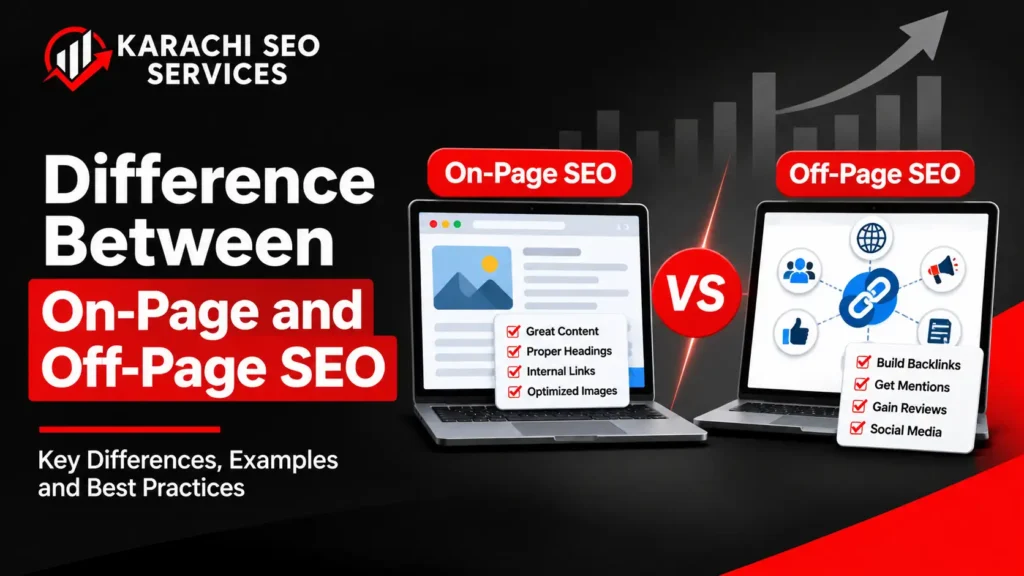
On-page SEO improves elements within your website, such as content, page titles, headings, and internal links. Off-page SEO builds your website’s reputation through external links, brand mentions, reviews, and online references.
Understanding both helps you create an SEO strategy that improves your website’s relevance, credibility, and search visibility.
What Is On-Page SEO?
On-page SEO involves optimizing website content, titles, headings, images, URLs, and internal links to make individual pages more useful and relevant to search queries. These improvements help search engines understand your content and visitors find the information they need.
Key Elements of On-Page SEO
- Keyword research: Find the search terms your audience uses and include relevant keywords naturally in your content. Keyword research helps identify these search terms.
- Title tags and meta descriptions: Write clear page titles and descriptions that explain what each page offers.
- Headings: Use H1, H2, and H3 headings to organize information into useful sections.
- Content quality: Answer visitors’ questions with accurate, original, and helpful information. Apply semantic SEO to cover related topics and entities naturally.
- Internal linking: Connect related pages using descriptive anchor text so visitors and search engines can discover more content. A clear internal linking strategy helps connect relevant pages.
- Image optimization: Use descriptive file names, useful alt text, and compressed image files.
- URL structure: Keep URLs short, readable, and related to the page topic.
- Content organization: Cover related questions and subtopics without repeating the same information.
These elements help search engines understand what a page covers and how it relates to a user’s search.
What Is Off-Page SEO?
Off-page SEO includes activities outside your website that help build its reputation and credibility. Unlike on-page SEO, much of this work depends on other websites, publishers, customers, and online communities.
For example, a relevant business website linking to your article can help people discover your content and provide a reference to your page.
Key Elements of Off-Page SEO
- Backlink building: Earn links from relevant and trusted websites in your industry. Understanding backlinks and their role in SEO helps you focus on link quality rather than quantity.
- Guest posting: Publish useful articles on other websites to reach new audiences and build industry relationships. A relevant guest post in SEO can also create opportunities to earn backlinks.
- Brand mentions: Get your business mentioned in relevant publications, blogs, and online discussions.
- Digital PR: Share expert opinions, research, and useful resources with journalists and publishers.
- Social media marketing: Share content on platforms such as Facebook, LinkedIn, Instagram, and YouTube to reach more people.
- Online reviews: Encourage genuine customers to review your business and respond to their feedback.
- Local citations: Keep your business name, address, and phone number (NAP) accurate across relevant directories and platforms. Local SEO citations help customers find consistent business information.
Quality matters more than quantity. A relevant backlink from a trusted industry website is generally more useful than hundreds of unrelated links. Avoid paid link schemes, fake reviews, and artificial brand mentions.
Difference Between On-Page and Off-Page SEO
The main difference is where the optimization takes place. On-page SEO focuses on your website, while off-page SEO focuses on how other websites and people refer to your business.
| Factor | On-Page SEO | Off-Page SEO |
|---|---|---|
| Main focus | Website content and page elements | External reputation and references |
| Location | Within your website | Outside your website |
| Control | Mostly controlled by you | Depends on external websites and people |
| Activities | Keywords, headings, content, images, and internal links | Backlinks, guest posts, digital PR, and brand mentions |
| Links | Internal links | External backlinks |
| Main purpose | Improve page relevance and usefulness | Build credibility and online recognition |
| Common tools | Google Search Console and keyword research tools | Ahrefs, Semrush, and backlink analysis tools |
On-Page SEO vs. Off-Page SEO: Example
Suppose you own a web development company in Karachi and want to rank for “web development services in Karachi.”
Your on-page SEO work would include:
- Creating a dedicated web development service page.
- Adding the target keyword naturally to the title and main heading.
- Explaining your services, process, and pricing factors.
- Showing real project examples and customer reviews.
- Linking to related website development services.
Your off-page SEO work would include:
- Earning backlinks from relevant technology websites.
- Getting your company mentioned in business publications.
- Building relationships with industry websites.
- Maintaining accurate business listings.
- Encouraging genuine customer reviews.
The service page explains what your business offers. External references help more people discover and recognize your company.
Which Is More Important: On-Page or Off-Page SEO?
Neither is always more important. The right priority depends on your website’s condition and competition.
If your pages have poor content, missing titles, or unclear information, start with on-page improvements. Building backlinks to pages that do not properly explain your services may not produce the results you want.
Once your important pages are useful and properly optimized, work on earning relevant backlinks and building your brand’s reputation.
For competitive search terms, both areas may need ongoing attention. Businesses targeting customers in a specific city may also need local SEO services to improve their visibility in local search results.
How Do On-Page and Off-Page SEO Help AI Overviews, AEO, and GEO?
Google AI Overviews, AI Mode, and other AI-powered search experiences use information from websites to help answer users’ questions. Answer Engine Optimization (AEO) and Generative Engine Optimization (GEO) focus on making useful information easier for answer engines and AI systems to understand and reference.
The same SEO foundations remain important: useful content, accessible pages, clear information, and genuine recognition. There is no special schema or guaranteed method that secures an AI Overview placement.
To make your content easier to understand and reference:
- Answer the main question directly near the beginning of the page.
- Use clear headings that describe the question or topic.
- Explain SEO terms in simple language.
- Include relevant entities, such as Google Search Console, backlinks, title tags, internal links, and digital PR, where they naturally fit.
- Add practical examples, comparisons, and accurate facts.
- Support important claims with reliable sources.
- Show real experience through examples, case studies, and expert contributions.
- Keep your business details, author information, and website content accurate.
On-page SEO helps make your information clear and accessible. Off-page SEO helps people discover your brand through relevant websites, publications, and references. Both can support your visibility across traditional search and AI-powered search experiences.
Frequently Asked Questions
What Is the Main Difference Between On-Page and Off-Page SEO?
On-page SEO improves elements within your website, including content, titles, headings, and internal links. Off-page SEO builds your website’s reputation through backlinks, brand mentions, reviews, and external references.
Are Backlinks Part of On-Page or Off-Page SEO?
Backlinks are part of off-page SEO because they come from external websites. Internal links connect pages within your own website and are part of on-page SEO.
Can a Website Rank Without Backlinks?
Yes. A website can rank without external backlinks, depending on the search query, competition, and content quality. However, relevant backlinks can help a website compete for more competitive searches.
Does Social Media Help With SEO?
Social media likes and shares are not direct Google ranking factors. However, sharing useful content can increase its reach, bring referral traffic, and create opportunities for natural backlinks and brand mentions.
What Is the Difference Between On-Page, Off-Page, and Technical SEO?
On-page SEO focuses on page content and elements such as headings and internal links. Off-page SEO focuses on external references and backlinks. Technical SEO covers crawling, indexing, website speed, mobile usability, and site structure.
How Do On-Page and Off-Page SEO Help AI Search?
On-page SEO makes website information clear and accessible, while off-page SEO helps build brand recognition and external references. Both support a website’s overall search visibility, but neither guarantees inclusion in AI-generated answers.
Improve Your Website’s Search Visibility
A successful SEO strategy needs more than keywords or backlinks. Your website should provide useful information, offer a good user experience, and earn recognition from relevant sources.
At Karachi SEO Services, we help businesses improve their websites through on-page SEO, off-page SEO, technical SEO, keyword research, and link building.